
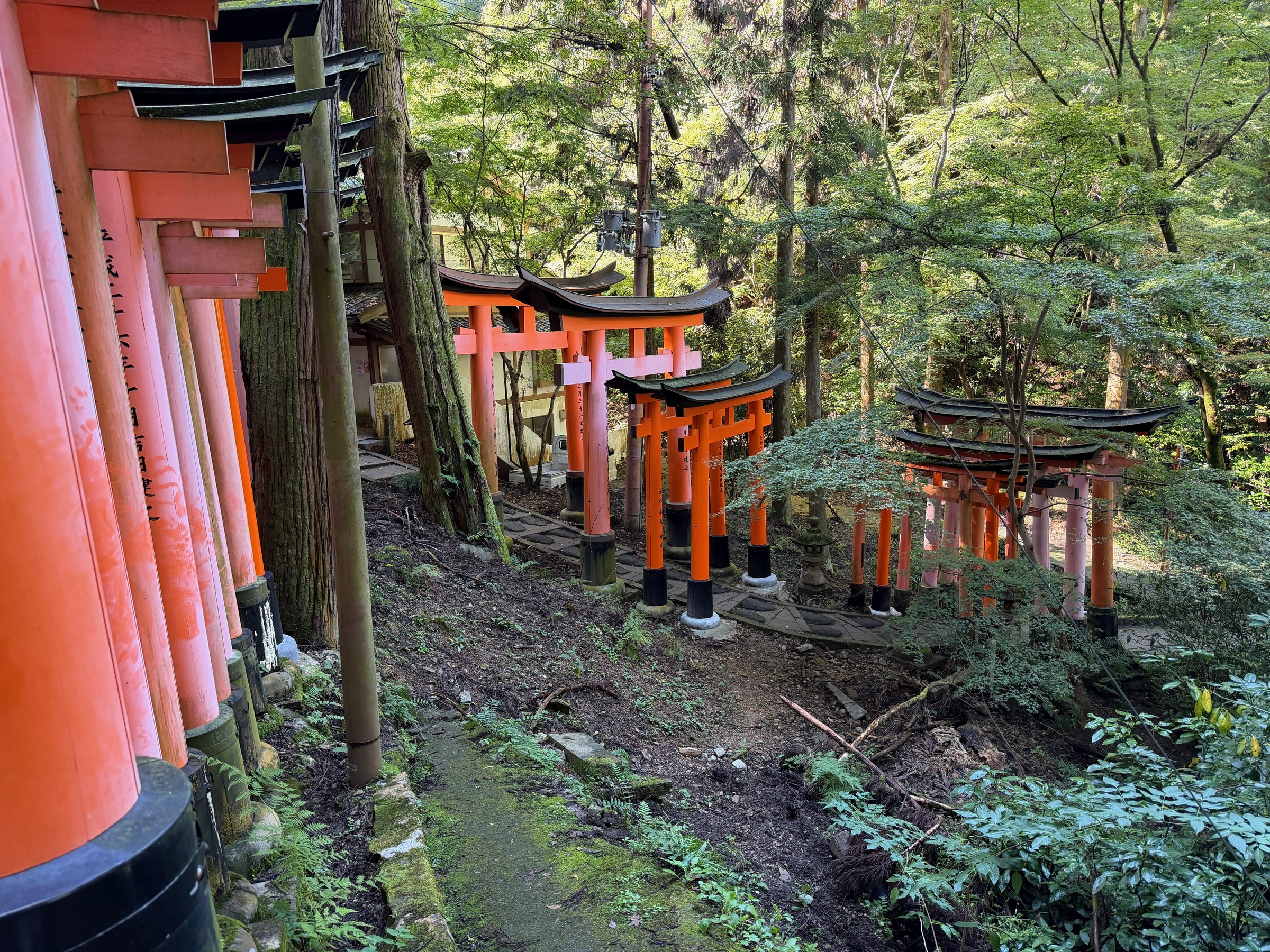
Everyone warns you that Kyoto is crowded, and everyone is right. But here’s what nobody tells you: at Fushimi Inari, the crowds are almost entirely at the bottom. Keep climbing for half an hour through the orange torii gates and the selfie sticks fall away, the forest closes in, and suddenly it’s just you, the stone steps and the sound of your own breathing. That hike was my favourite moment of a long weekend packed with them.
Kyoto is one of the easiest weekends you can do from Seoul. Steve and I flew Peach from Gimpo on a Thursday morning and were eating onigiri in downtown Kyoto by late afternoon. Over four days we walked Gion by lantern light, climbed Fushimi Inari, drank our way through an izakaya crawl, saw the Golden Pavilion, and ate far too much soft serve. Here’s everything we did, what it cost, and what I’d do differently.
Thursday: onigiri, Gion by lantern light and Top 100 ramen
We flew Peach MM736 from Gimpo at 11:20. Two hours later we were descending over Osaka Bay.
Peach lands at Kansai Airport’s Terminal 2, and there are no trains from there. Hop on the free shuttle bus to Terminal 1 (about 8 minutes), then follow the signs to the JR station for the Haruka limited express, which runs straight to Kyoto in about 75 minutes. If you have a foreign passport, buy the HARUKA One-way Ticket for ¥2,200 instead of the regular fare (about ¥3,070). You can get it as a QR e-ticket before you fly, or at the JR West office in Terminal 1.

Hyatt Place Kyoto
We stayed three nights at Hyatt Place Kyoto for 45,000 World of Hyatt points, which works out to 15,000 points a night. Our room was 25 m² with two twin beds and a sofa bed, which is roomy by Japanese standards. The real win is location: the hotel sits right on top of Marutamachi station on the Karasuma subway line, a few stops from Kyoto Station and an easy walk to downtown. It was a great base, and I’d happily book it again.
Onigiri at Onimaru
Our first stop was downtown for a snack at Onimaru, an onigiri counter near Shijo-Kawaramachi, right by Nishiki Market. We ate ours right there on the street. Exactly the welcome-to-Japan snack you want after a flight.

A night walk through Gion
At 5:45 we joined the Kyoto Gion Walk with Local: Culture & Geisha World, an Airbnb Experience run by Michael’s team at Kansai Navi. It meets under a big red umbrella at exit 9 of Gion-Shijo station, lasts about two and a half hours, and costs from ₩26,600 per person (about US$18). It has a 4.99 rating from over 300 reviews, and I can see why.
It had just rained, so the stone streets were shining. We started on the Shirakawa canal, lined with wooden teahouses and willows, then stopped at the tiny Tatsumi shrine and bridge, the guardian shrine of the geiko (the Kyoto word for geisha). From there we walked under the enormous Chion-in gate, through Maruyama Park, along Nene-no-michi and Ninenzaka, past the Yasaka pagoda, and finished on Hanamikoji, the heart of the geiko district. Seeing all of it lit up at night, with stories at every corner, was a lovely first evening in Kyoto. One thing I learned: in Kyoto they’re called geiko, not geisha, and locals will gently correct you.


Dinner at Japanese Ramen Yukou
We finished the night at Japanese Ramen Yukou in Higashiyama, a short walk from where the tour ended. A sign out front says it was selected as one of the Top 100 ramen shops in Japan. The ramen came in a light, clear broth with tender slices of meat, a pile of green onions and a slice of lemon, plus a side of crispy gyoza and a little glass of sake. A perfect first-night dinner.

Friday: Fushimi Inari to the top, temples and an izakaya crawl
Fushimi Inari: keep climbing
Fushimi Inari Taisha is free and open around the clock, and it’s two stops from Kyoto Station on the JR Nara line. We got there at about 10:40, which on a sunny November Friday meant one thing: crowds. The main gate and the first famous tunnel of torii, Senbon Torii, were shoulder to shoulder with tour groups, kimono rentals and selfie sticks.

The secret is simply to keep going. The paths wind up Mount Inari through thousands of orange gates, and with every flight of stone steps the crowd thins. About an hour in we reached a viewpoint over the whole city, stopped at a little teahouse for a soft serve, and kept climbing. By noon, on the upper paths through the cedar forest, we had long stretches of torii completely to ourselves. That quiet, green, orange-gated walk was the highlight of my whole trip.


Give yourself two to three hours for the loop, wear proper shoes (it’s a lot of steps), and on the way down, look out for the cats napping on the stone walls.
For lunch we walked a few minutes from the shrine to Dragon Burger, which hit the spot after all those stairs: a thick burger, fries and a cold drink.

Tofuku-ji
Next was Tofuku-ji, one stop up the line. It’s one of Kyoto’s most famous autumn-leaf spots, but in early November the maple valley was still green, so we paid ¥500 for the Hojo garden instead: neatly clipped azalea hedges and moss around the abbot’s hall, and far fewer people than Fushimi Inari.

Kodai-ji, a bamboo grove and matcha
In the afternoon we crossed to Higashiyama, past Yasaka Shrine and the pond in Maruyama Park, to Kodai-ji (¥800). This was where we saw our first real autumn colour: red maples reflected in the garden pond under a perfect blue sky. Behind the temple there’s a small bamboo grove, a calm alternative to Arashiyama. We finished with matcha and a sweet at the temple’s tea seat for ¥800, looking out over the garden.


As the sun dropped we walked down Nene-no-michi, where a rickshaw was parked in front of the Yasaka pagoda. Golden hour in Higashiyama is something else.

Izakaya bar crawl, then karaoke
Friday night was the Kyoto: Izakaya Bar Crawl with Local Guide Airbnb Experience, run by Travel Japan Together. It starts at 7pm in front of the Disney Store at Shijo-Kawaramachi and lasts about three hours. It’s from US$38 per person, and food and drinks are paid separately: the listing estimates about ¥6,000 per person across the three stops.
The first stop was a traditional izakaya, where our whole group crowded around low tables for rolled omelette, tomatoes, fried snacks and beer. Next came a sake bar for a tasting, and finally a hidden whisky bar with a wall of bottles. Going with a group made it easy to try things we’d never have ordered on our own, and the night ended at karaoke well past 1am.

Saturday: the Golden Pavilion, a rock garden and tonkatsu
After a late night, we took it slow and headed to northwest Kyoto by city bus. A fun fact about Kyoto buses: you get on through the back door, and you pay when you get off, at the front, next to the driver. Inside the central zone it’s a flat ¥230 a ride, and you can tap an IC card like ICOCA or Suica. City bus 205 runs from Kyoto Station to Kinkaku-ji in about 40 minutes.
Kinkaku-ji
Kinkaku-ji, the Golden Pavilion, costs ¥500 and is just as unreal in person: a gold-leaf temple reflected in a still pond, with pine-covered hills behind it. It’s also one of the busiest places in Kyoto. The path is one-way and the main viewpoint over the pond was packed several rows deep, so be patient, wait your turn at the railing, and keep walking: there are quieter angles of the pavilion further along the path.

Ryoan-ji
From Kinkaku-ji, Ryoan-ji is a 20-minute walk or a short bus ride west (¥600). Its famous rock garden is just raked white gravel and fifteen stones, and everyone sits on the wooden veranda in silence trying to work out what it means. Don’t skip the grounds: the big Kyoyochi pond with its lily pads and the quiet forest paths were some of the most peaceful spots of the weekend.


Dinner at Katsukura
For dinner we went to Katsukura at Shijo-Higashinotoin, a Kyoto tonkatsu chain. You start by grinding your own sesame seeds in a little bowl for the sauce, and then out comes crispy, juicy pork cutlet with a mountain of shredded cabbage, rice and miso soup.

Gion after dark
We walked off dinner with another wander through Gion at night: tiny glowing street shrines, a fish-shaped taiyaki from Naruto Taiyaki Honpo, and the quiet lanes off Hanamikoji, where we spotted a woman in kimono slipping down a side street. Kyoto at 10pm is a completely different city from Kyoto at noon.
Sunday: a lantern bridge, a giant gate and one last market crawl
Heian Shrine garden
Our last morning started at Heian Shrine. The shrine grounds are free, but the real treat is the garden behind it (¥600). Walk all the way round to the pond and you reach a covered wooden bridge hung with white paper lanterns, with benches looking out over the water and a pavilion reflected in it. It’s the perfect place to sit for ten minutes and do nothing. Good to know: parts of the shrine are under renovation until 2030, but the garden is open as normal.

Chion-in
A short walk south is Chion-in, home of the giant Sanmon gate we’d walked under in the dark on Thursday. By daylight it’s even more impressive, and a maple in front of it had already turned bright red. Outside, a street stall was selling satsuma butter, sweet potato with butter, which we obviously had to try.


Kamo River and Nishiki Market
We crossed the Kamo River at Shijo bridge, where people were sitting along the banks in the sun, and grabbed an iced matcha latte topped with soft serve on the way to Nishiki Market. Nishiki is a covered street of food stalls hung with red lanterns, and it’s where we spent our final hour: snacking, browsing, and finishing with one last soft serve each, matcha and vanilla.


Then it was back to Kyoto Station, the Haruka to Kansai, and an evening Asiana flight home to Gimpo. One last tip: grab a pair of the striped 7-Eleven socks before you leave. They’re a fun little convenience-store souvenir, and they take up no space in a carry-on.
The not-so-great bits
- Fushimi Inari is mobbed at the bottom. By 10:40 on a Friday the first stretch of gates was shoulder to shoulder. Skip the sunrise alarm: arrive mid-morning and keep climbing. Past the halfway viewpoint it’s a different place.
- Kinkaku-ji is a crowd, full stop. It’s a one-way loop and everyone wants the same photo from the same railing. Go right at the 9am opening if you can, and budget patience if you can’t.
- Peach lands at Terminal 2. There are no trains there, so add 15 to 20 minutes for the shuttle bus to Terminal 1 before you can catch the Haruka.
Would I go back to Kyoto?
Absolutely. It’s under two hours from Gimpo, the food is incredible, and there’s far more to it than the famous postcard spots. The trick is timing: go early, go higher, and save the old streets of Gion for after dark.
Want the whole weekend in 16 seconds? Watch the reel.
How I’d plan a long weekend in Kyoto
- Day 1: Fly to Kansai, Haruka to Kyoto, onigiri near Nishiki Market, an evening Gion walking tour, ramen.
- Day 2: Fushimi Inari as early as you can, all the way up. Burger lunch, Tofuku-ji, then Kodai-ji and Nene-no-michi at golden hour. Izakaya crawl at night.
- Day 3: Bus to Kinkaku-ji, walk to Ryoan-ji, tonkatsu at Katsukura, Gion after dark.
- Day 4: Heian Shrine garden, Chion-in, Kamo River, Nishiki Market, Haruka to the airport.
Where we stayed, ate and drank
- Hyatt Place Kyoto, Marutamachi: our hotel, right on top of the subway
- Onimaru, Shijo-Kawaramachi: onigiri
- Kyoto Gion Walk with Local, Gion: evening walking tour
- Japanese Ramen Yukou, Higashiyama: ramen and gyoza
- Dragon Burger, Fushimi Inari: burger lunch after the hike
- Kodai-ji, Higashiyama: garden, bamboo grove and matcha
- Izakaya Bar Crawl with Local Guide, Shijo-Kawaramachi: three bars in one night
- Katsukura, Shijo-Higashinotoin: tonkatsu
- Nishiki Market, downtown: snacks and soft serve
Leave a Reply